


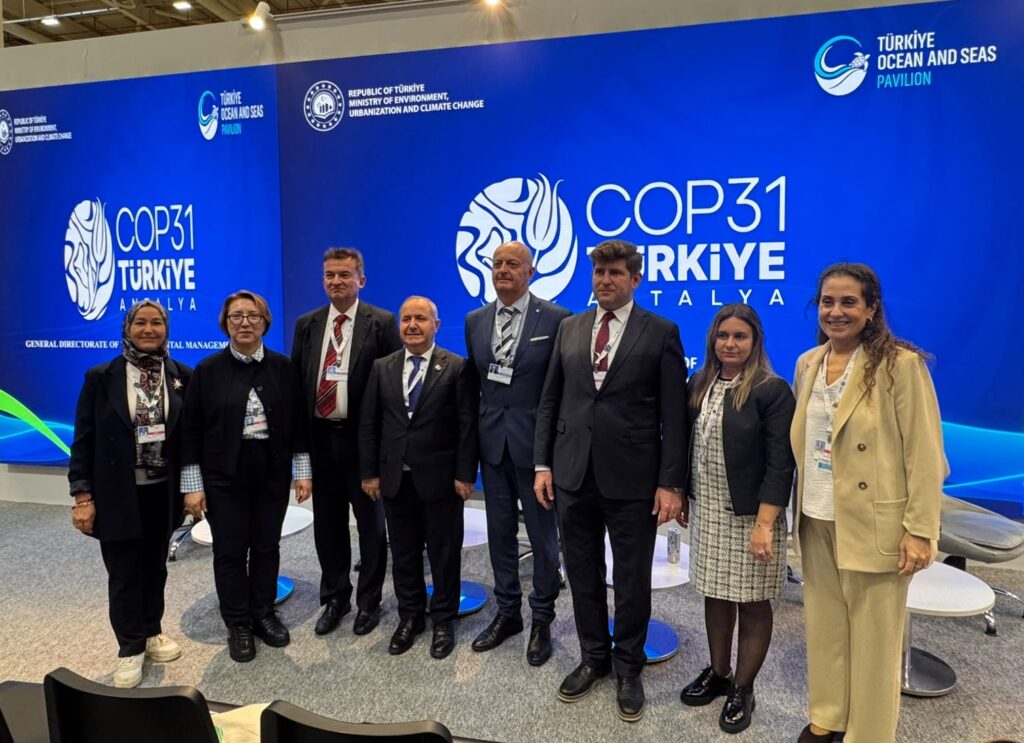
PAP/RAC Deputy Director, Mr. Prem participated in the 31st Conference of the Parties to the United Nations Framework Convention on Climate Change (COP31), held from 13 to 17 November 2026 in Antalya, Türkiye, contributing to international discussions on integrated coastal zone management, climate change adaptation and resilient coastal areas.
During the conference, he contributed as a speaker to two side events focusing on the challenges and opportunities of building climate-resilient Mediterranean coasts.
On 14 November, at the Mediterranean Pavilion, he took part in the side event “Beyond 1.5°C: What Changes and How Do We Adapt? Lessons from the Mediterranean”, organised by CC/RAC and UNESCO. His presentation, “Coastal Plans – Climate Adaptation and Resilience”, highlighted the importance of developing and implementing coastal adaptation plans, prioritising nature-based solutions and strengthening the resilience of coastal ecosystems and those in the hinterland.
On 17 November, at the Türkiye Oceans and Seas Pavilion, he contributed to the panel “From Land to Sea: Integrated Coastal Zone Management and Maritime Spatial Planning for Climate-Resilient Coasts”, organised by the Ministry of Environment, Urbanisation and Climate Change of Türkiye.
The panel brought together experts and representatives from Türkiye and the Mediterranean region to explore how integrated coastal zone management (ICZM) and marine spatial planning (MSP) can complement each other in addressing climate change impacts on coastal areas.
In his contribution, Marko Prem presented lessons from the Coastal Area Management Programme (CAMP), implemented under the Barcelona Convention, and introduced the CAMP Türkiye project, which the Ministry and PAP/RAC plan to implement jointly in the Gulf of Çandarlı, İzmir. The project will provide an opportunity to apply integrated coastal management approaches in addressing the challenges facing this coastal area.
The discussions also highlighted the importance of planning land and sea areas together, particularly in view of increasing risks such as sea-level rise and compound flooding. The contributions from the different panellists illustrated the value of combining integrated coastal zone management, marine spatial planning and nature-based approaches to strengthen climate resilience.
Both side events generated lively discussions and provided an opportunity to present PAP/RAC’s work in greater detail, particularly its support to Mediterranean countries in applying the ICZM Protocol and developing practical approaches to coastal adaptation.
A key message throughout the discussions was that the ICZM Protocol provides an important international legal framework and concrete instruments for addressing climate change impacts in coastal zones. However, effective adaptation requires translating strategic priorities into concrete implementation measures, with particular attention to nature-based solutions and the resilience of both coastal and hinterland ecosystems.
In addition to his contributions as a speaker, Mr. Prem participated in other COP31 side events organised by MedWaves (SCP/RAC), UNEP/MAP and various countries and partners, further strengthening exchanges and cooperation within the Mediterranean community.
PAP/RAC’s participation in COP31 reaffirmed the importance of ICZM as a key approach to climate change adaptation and the development of resilient Mediterranean coastal communities and ecosystems.